Flashcards work for language learning. But most people use them in ways that feel productive without building the kind of knowledge that transfers to real understanding. After years of language learning and a lot of failed experiments, here's what I've actually found makes a difference.
The mistakes that waste your time
The most common mistake is studying isolated words. You learn "rapido = fast" as a raw translation pair, and you can recall it in a flashcard context, but you struggle to use it naturally in speech. That's because you've learned a mapping between two symbols, not a sense of how the word actually lives in the language.
Inconsistent reviewing is the other big killer. Flashcard systems run on regularity. Spaced repetition only works if you show up when cards are due. Skipping a week and coming back to 200 overdue cards is demoralizing and ineffective. The whole design of the method assumes daily or near-daily use.
A subtler mistake is using flashcards for grammar rules. "When to use ser vs. estar" is not a good flashcard topic. Grammar is a system of patterns, and it clicks through exposure and use, not through memorizing declarative rules. Flashcards are well-suited to vocabulary, phrases, and specific forms. They're not well-suited to teaching you how to think in a language.
Finally, passive reading of flashcards doesn't do much. Flipping through cards and reading the answers without testing yourself is essentially re-reading your notes. It feels fine, but it's not triggering the active recall that actually builds memory.
What actually helps
Sentence-level cards beat single words every time. Instead of "casa = house," a card that shows a sentence like "Me gusta estar en casa los domingos" and asks you to understand or translate it forces you to process the word in context. Even better, write your own sentences using the words you're learning. Creating the sentence is itself a learning act.
Connect vocabulary to things you already care about. If you're learning Italian because you want to travel to Rome, build decks around food, directions, and common situations. If you're learning Japanese because you love a specific TV show, start with vocabulary from that show. The personal relevance makes a real difference in retention because your brain tags emotionally or practically relevant material as worth keeping.
Short daily sessions are far better than long occasional ones. Twenty minutes a day beats two hours on Saturday. The daily practice keeps the language active in your memory, and it's also more sustainable as a habit.
Combine flashcards with input. Read things in your target language. Watch content. Listen to podcasts. Flashcard review and language exposure aren't competing activities, they reinforce each other. A word you encounter in the wild after studying it on a flashcard sticks harder than a word you've only ever seen in the app.
What flashcards can't do
Let's be direct: flashcards alone won't make you fluent. They're a vocabulary and phrase acquisition tool. They don't teach you to think in real time, handle fast native speech, navigate a conversation when the other person goes off script, or produce language under social pressure.
You need conversation practice for that. You need to speak, stumble, get corrected, and try again. Flashcards prepare you to have more of those conversations successfully by giving you the building blocks, but they don't replace the practice itself.
Listening is its own skill. You can know every word in a song and still struggle to catch them when the song plays at normal speed. Ear training requires listening to real spoken content at real speed, a lot of it.
Use flashcards for what they're genuinely good at: building vocabulary and phrase recognition systematically, at whatever pace works for you, without forgetting what you've already learned. That's a meaningful contribution to language learning. It's just not the whole picture.
Getting started
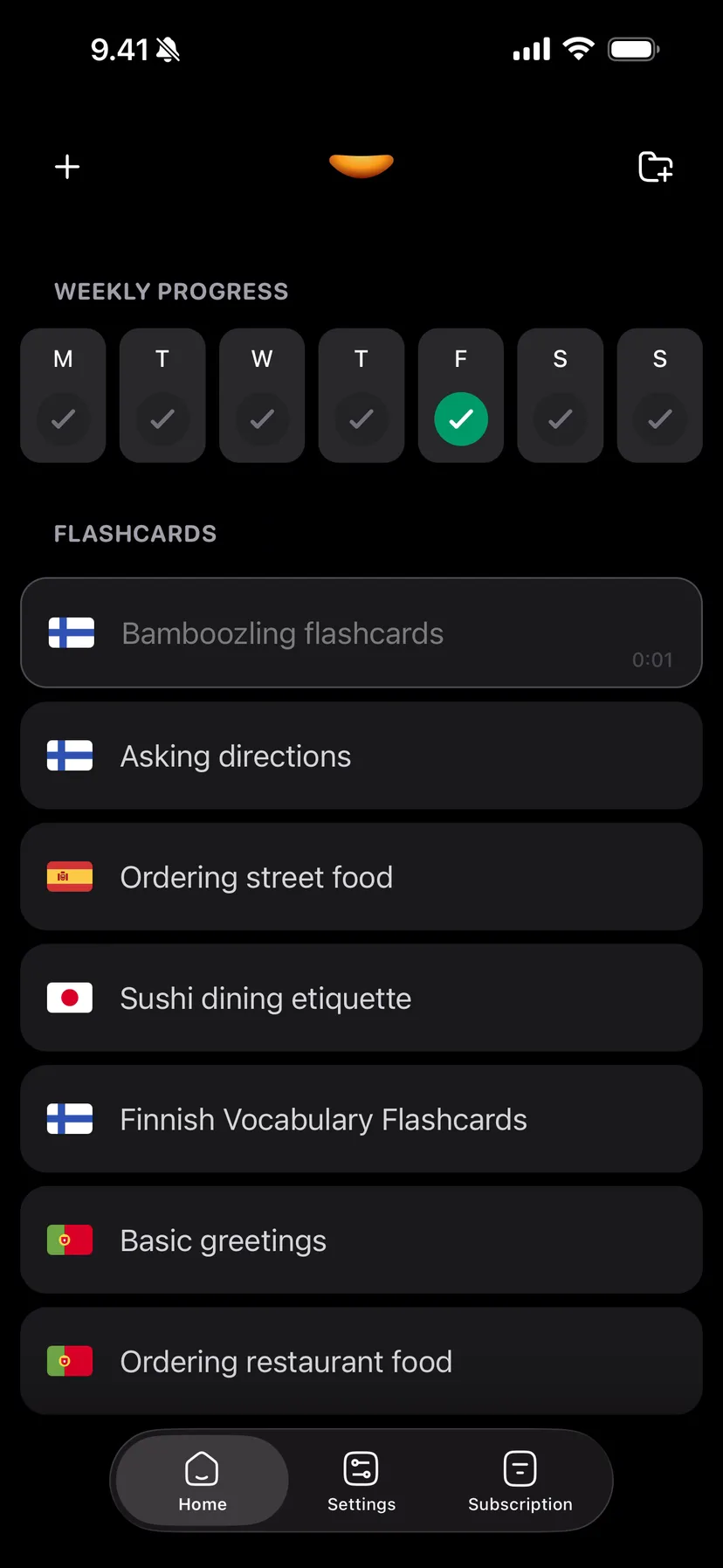
If you want a system that doesn't require a lot of setup, Vocabbie lets you generate flashcard decks from your notes or a topic description, with example sentences included. The spaced repetition is built in, so you can start studying immediately without configuring anything. The hard part, as with all language learning, is just showing up consistently.