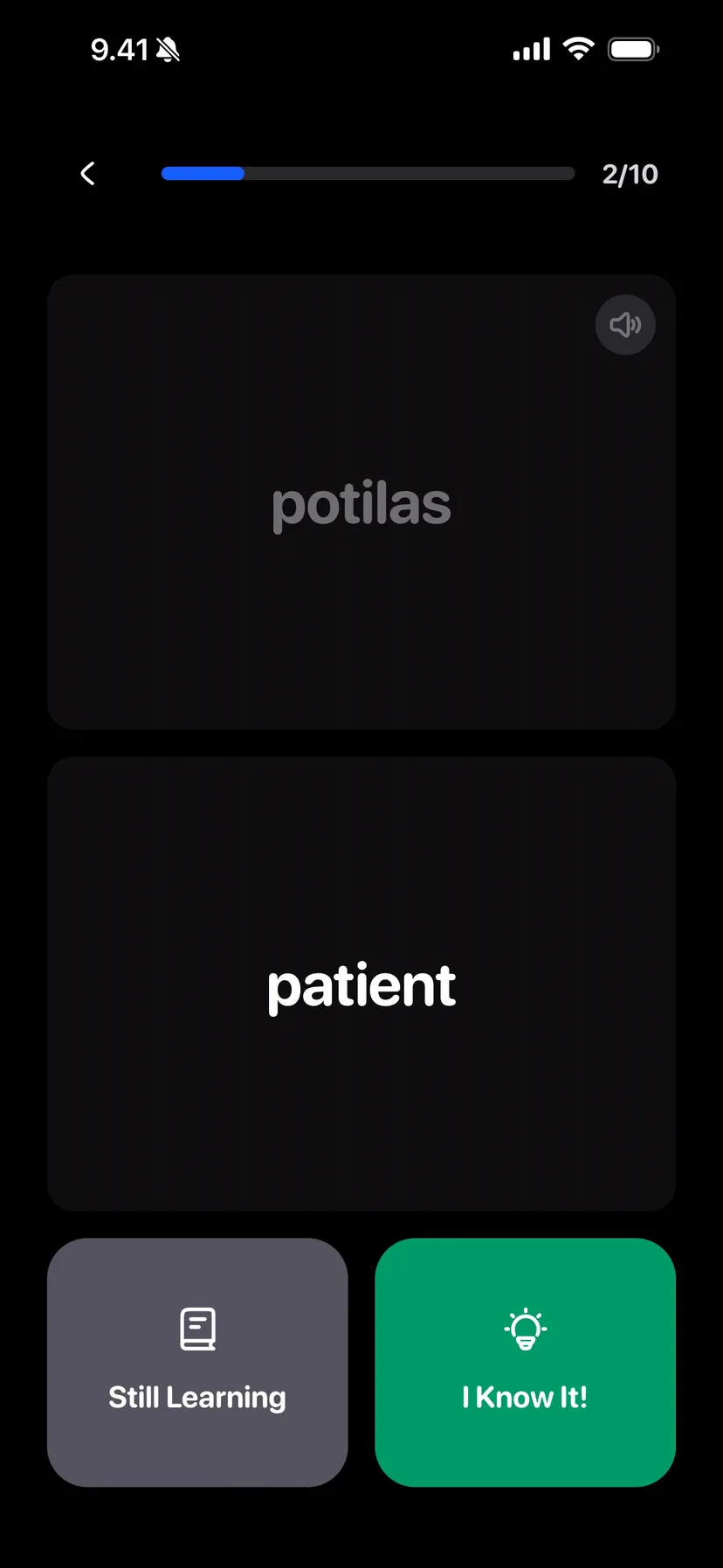
Most people study vocabulary by looking at a word, reading the definition, nodding, and moving on. Then they wonder why they can't remember anything a week later. The problem isn't effort. It's the method.
Why cramming fails
Hermann Ebbinghaus figured this out in the 1880s. He ran memory experiments on himself and plotted what he called the forgetting curve: after learning something new, you lose most of it within 24 hours if you don't revisit it. Not some of it. Most of it. By day seven, what's left is a shadow.
Cramming works against this curve. You sit down, read 50 words, feel like you've done something productive, and close the book. What you've actually done is give each word one pass through your brain, which is barely enough to register it, let alone hold onto it.
The other issue with cramming is that it's passive. You read, you recognize, you think you know. Recognition and recall are completely different things. Recognizing a word when you see it doesn't mean you can produce it when you need it.
What actually works
Active recall is the simplest thing you can do that actually makes a difference. Instead of reading a word and its definition, cover the definition and try to retrieve it. Get it wrong, check the answer, try again. This forces your brain to do real work, and the struggling is the point. The harder the retrieval, the stronger the memory trace.
Spacing is the other half of the equation. Instead of reviewing everything in one session, spread reviews out over time. Study a word today, review it tomorrow, then in three days, then a week later. Each time you successfully recall something, you push the next review further out. This is spaced repetition, and it's the closest thing to a memory cheat code that actually exists.
Both of these are most effective when they're automated. Doing the scheduling by hand is impractical, which is why good flashcard systems handle it for you.
Make it personal and connected
Here's what separates vocabulary that sticks from vocabulary you keep re-learning: connection. A word attached to nothing in your memory is hard to hold. A word attached to an image, a sentence, a joke, something you care about, that's a different story.
When you learn a new word, don't just learn the dictionary definition. Find a sentence that uses it in context. Better yet, write your own. If you're learning Spanish and you pick up the word "madrugada" (the hours between midnight and dawn), don't just memorize "madrugada = early morning hours." Think about a specific time you were awake at 3am. Now the word has somewhere to live.
This is also why word lists are mostly useless. A list of 500 common words in isolation, ranked by frequency, is probably the worst way to learn vocabulary. Words in context carry meaning. Words in lists carry nothing.
Context over lists, always
The research on this is pretty consistent: learning vocabulary in context leads to better retention and better ability to use words actively. That means reading, listening, watching things in your target language, and picking up words as you encounter them. The difference between a word you learned from a list and a word you first heard in a movie scene you remember is enormous.
This doesn't mean flashcards are useless. It means the best flashcards don't strip words of their context. They include example sentences. They show you how a word actually behaves in the language.
Putting it together
Here's a realistic approach that works: encounter words in context (through reading, media, or conversation), add the most important ones to a flashcard system with example sentences, and let spaced repetition handle when you review them. Short sessions daily beat long sessions once a week.
The hardest part is consistency. Not the studying itself, just showing up every day for ten minutes.
If you want a system that handles the card-creation and scheduling for you, Vocabbie does both. You describe what you want to learn or paste in your notes, and it builds the cards with context included. The spaced repetition is built in. The only thing you have to do is show up and review.