If you've ever felt like you're stuck on a vocabulary treadmill, memorizing words one day only to forget them the next, you're not alone. The common approach of simply translating a single word from your target language into your native one, then trying to drill it, is a massive waste of effort. I know, because I've done it. We all have. We write down "dog = perro" and think we're learning, but what we're really doing is setting ourselves up for frustration.
This method fails for a simple reason: words don't exist in a vacuum. They are tools for communication, shaped by context, nuance, and association. Stripping a word down to a single, direct translation robs it of all that richness, making it incredibly difficult for your brain to form lasting connections. You might pass a quiz on isolated words, but try to use them in a real conversation, and you'll often find yourself fumbling.
Why direct translation misses the point
Think about a word like "bank" in English. If you just learn "bank = Flussufer" (river bank) or "bank = Geldinstitut" (money institution) as separate entries, you're doing a disservice to your learning. The word itself carries a core meaning, but its usage depends entirely on the surrounding words and situation. When you only learn the direct translation, you're not learning the concept or how to use the word. You're learning a fragile link between two isolated items, easily broken and rarely applicable in real-time speech or comprehension.
This is why many language learners hit a plateau. They can recognize a decent number of words, but they struggle to form coherent sentences or understand natural speech. Their vocabulary is a collection of individual bricks, not a sturdy wall. The trick is to build that wall, not just gather bricks.
Context is everything
The best way to learn vocabulary is to always, always, always learn it in context. This means seeing or hearing the word used in a sentence, a phrase, or a paragraph. When you encounter a new word, don't just look up its direct translation. Look up its definition in the target language first, if you can. Then, find example sentences. Notice how the word interacts with other words, what prepositions it uses, what kind of verbs or nouns it pairs with.
For instance, instead of just "verstehen = to understand," learn "Ich verstehe dich nicht" (I don't understand you) or "Ich habe das Thema gut verstanden" (I understood the topic well). These phrases immediately give the word a home. They show its grammar, its common uses, and its natural rhythm. Your brain is wired to make sense of patterns and relationships, and context provides those patterns.
Flashcards that actually work
This is where flashcards truly shine, but not the single-word kind. To create effective flashcards, you need to embed context. Here's how I approach it:
- Sentence-based cards: On the front, put a sentence in your target language with the new word omitted or highlighted. On the back, have the full sentence with the word, its definition in the target language, and perhaps a concise translation of the entire sentence if you're a beginner. This forces you to recall the word in its natural habitat.
- Image association: For concrete nouns or verbs, use images. Instead of "cat = gato," put a picture of a cat on the front and "gato" on the back. This bypasses your native language entirely, building a direct link between the concept and the target word.
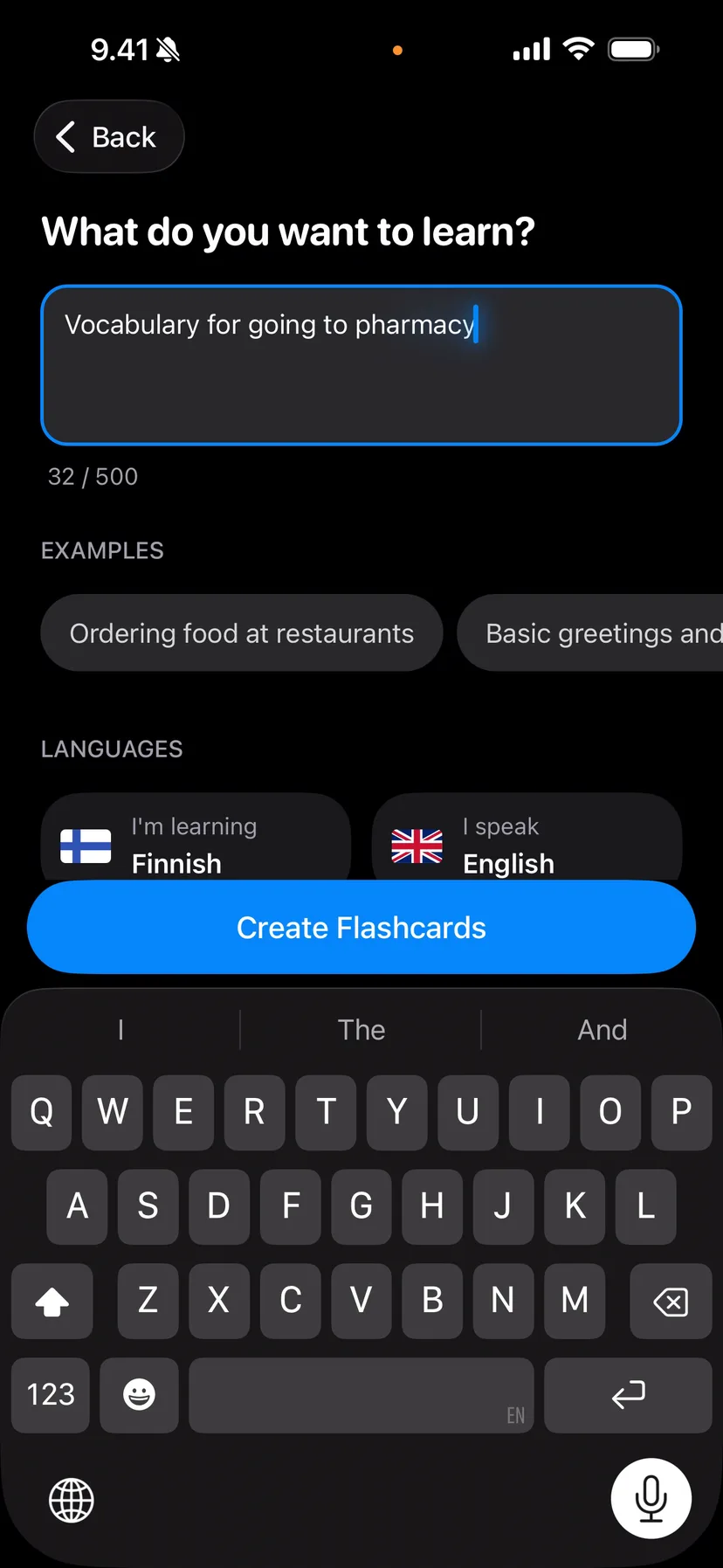
- Target language definitions: As you advance, try to define words using only the target language. This pushes you to think in the language, rather than constantly translating back and forth. Vocabbie's AI is incredibly helpful here, letting you generate example sentences, definitions, and even related terms with just a tap, making it easy to create these rich, contextual cards. If you want to dive deeper into making your flashcards effective, I recommend checking out our guide on how to actually learn a language with flashcards.
Once you have these robust flashcards, you need a system to ensure you remember them long-term. This is where spaced repetition comes into play. Spaced repetition algorithms, like the one Vocabbie uses, schedule your reviews for you, showing you cards right when you're about to forget them. This optimizes your learning sessions, making sure every minute you spend studying is highly effective. It moves words from your short-term memory into your long-term storage, exactly where you need them to be for fluent conversation and comprehension.
Immerse and interact
Beyond flashcards, actively seek out opportunities to encounter your new vocabulary in the wild. Read books, watch movies, listen to music, and try to speak with native speakers. The more you see and hear words in various contexts, the stronger those neural connections become. Don't be afraid to make mistakes; they are part of the learning process.
When you're studying, make sure you're truly focused. It's easy to passively skim through flashcards or text. Engage actively. Ask yourself questions. Try to create new sentences with the words you're learning. If you struggle with staying on task, our post on how to actually focus while studying offers practical tips you can use right away.
Learning vocabulary isn't about collecting a list of translations. It's about building a living, breathing network of words and concepts in your mind. It's about understanding how language works, not just what individual pieces mean. By embracing context, active recall with intelligent flashcards, and consistent, focused practice, you'll move past the endless cycle of memorization and forgetting, and genuinely start to master the vocabulary of any language.