The debate between digital and paper flashcards has been around for a while, and honestly, it’s not about one being definitively better. Both have distinct strengths. The real secret to effective studying is knowing when to grab a stack of index cards and when to open your favorite flashcard app. I’ve used both extensively throughout my own academic journey, and I’ve found that the best approach often involves a smart combination of the two.
Why do people stick with paper flashcards?
Many students choose paper flashcards because they offer a unique tactile and distraction-free learning experience. When you write something down, your brain engages differently compared to typing, which can sometimes aid initial memorization and understanding.
There’s a comfort in physically writing out a question and answer. This act of creation, the kinesthetic movement of forming letters, can solidify information in a way that just typing might not. Research, like a 2014 study from Princeton and UCLA, has even suggested that taking notes by hand can lead to better conceptual understanding and retention than typing. While not directly about flashcards, this highlights the power of physical interaction with your study materials. Paper flashcards also offer a complete escape from screens. In an age of constant notifications and digital alerts, a stack of physical cards provides a quiet, focused study zone without any tempting distractions just a tap away. Plus, they never run out of battery.
When are paper flashcards your best option?
Paper flashcards are excellent for situations requiring quick, on-the-fly creation, visual aids, or when you need a screen break.
- Quick concept checks: If you're in a lecture and want to jot down a few key terms immediately, or need to test yourself on a handful of formulas right before a test, paper is fast and requires no setup.
- Diagrams and complex visuals: For subjects like anatomy or engineering, where sketching diagrams, labeling parts, or drawing flowcharts is essential, paper cards give you the freedom to illustrate exactly what you need without wrestling with digital drawing tools.
- Initial learning and active creation: The act of physically writing information down can be a powerful form of active recall right from the start. You're not just copying and pasting; you're processing and reproducing the content. This is a form of "retrieval practice" where recalling information strengthens your memory of it.
- Collaborative study: When you're studying with a group, physical flashcards are easy to pass around, sort, and discuss, fostering a more interactive learning environment.
Why do digital flashcards outperform paper for long-term mastery?
Digital flashcards are superior for long-term memorization, efficiency, and managing large volumes of information thanks to features like spaced repetition and AI integration. They harness advanced cognitive science principles that paper simply can't.
The biggest advantage of digital flashcards is spaced repetition. This is a learning technique where you review material at increasing intervals over time, showing you cards you struggle with more frequently and cards you know well less often. This system is based on the "forgetting curve" identified by Hermann Ebbinghaus in the late 19th century, which shows how information fades from memory over time if not reinforced. A well-designed spaced repetition algorithm, like the one in Vocabbie, ensures you review information precisely when you're about to forget it, maximizing retention with minimal effort. You can learn more about this powerful technique in our post on why your brain needs spaced repetition.
Digital apps also offer unparalleled convenience and accessibility. Your entire library of flashcards is always in your pocket, accessible from your phone or tablet. This means you can squeeze in a quick review session while commuting, waiting in line, or whenever you have a few spare minutes, turning otherwise wasted time into productive study.
How do AI-powered flashcards take studying to the next level?
AI-powered flashcards, like those offered by Vocabbie, dramatically reduce creation time and optimize your study schedule, making learning more efficient and personalized.
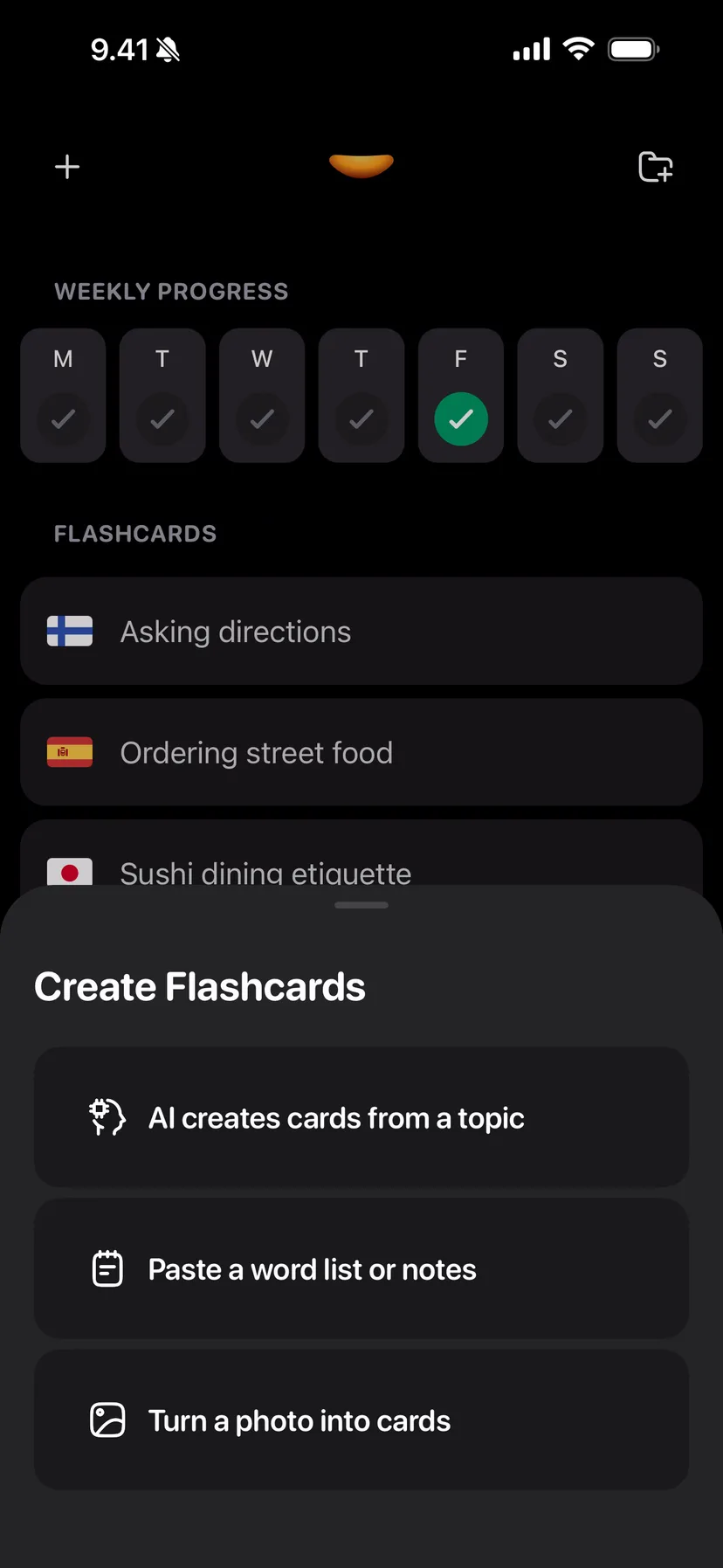
Vocabbie, a language-learning app for iPhone, Android and the web, uses artificial intelligence to streamline the entire flashcard process. Imagine taking a photo of your lecture notes or pasting text from a textbook, and with a tap, having an AI automatically generate relevant flashcards. This completely removes the tedious setup phase, allowing you to jump straight into studying. You can even create flashcards from a photo directly in the app.
AI can also personalize your learning path, tailoring reviews to your individual performance. It identifies your weak areas and ensures those challenging concepts get the attention they need. This intelligent adaptation helps you focus your limited study time exactly where it will have the most impact. For anyone facing a huge amount of material, like students preparing for the GRE or MCAT, or those learning a new language, this efficiency is a game-changer. For instance, if you're tackling thousands of new terms for a certification, an app like Vocabbie helps you manage the workload by prioritizing what you need to review, unlike a static stack of paper cards. This makes it ideal for fields like medicine, where you might need to learn medical terminology fast.
When should you choose digital flashcards?
Digital flashcards are the clear winner for extensive learning, long-term retention, and when you need smart, adaptive study tools.
Here’s when I strongly recommend going digital:
- Learning vast amounts of information: If you’re studying for the GRE, mastering a new language, or tackling complex medical vocabulary, the sheer volume of material makes digital organization and spaced repetition essential. This is especially true if you want to memorize vocabulary fast or effectively learn a language with flashcards.
- Maximizing long-term retention: For concepts you need to remember for months or years, the spaced repetition algorithm is non-negotiable. It systematically prevents forgetting without you having to manually track review dates.
- Efficient study on the go: Any time you have a few minutes during your day, you can pull out your device and review. This micro-learning adds up significantly over time.
- Leveraging multimedia: Digital flashcards allow you to include images, audio, and even video clips, which can be incredibly helpful for subjects like language learning (pronunciation) or visual identification.
- Saving time on creation and organization: AI features that generate flashcards from your notes or text, coupled with easy editing and tagging, save countless hours compared to writing out cards by hand. If you have extensive notes, you can even learn how to turn your notes into flashcards with AI.
Ultimately, the best strategy isn't about choosing one over the other. It's about smart integration. Use paper flashcards for their immediate, tactile benefits – for initial concept mapping, quick, distraction-free reviews, or when you simply need a screen break. Then, transition that information into a powerful digital tool like Vocabbie for the long haul, letting spaced repetition and AI ensure you truly master the material. By understanding the unique strengths of each, you can build a more effective, efficient, and enjoyable study routine.